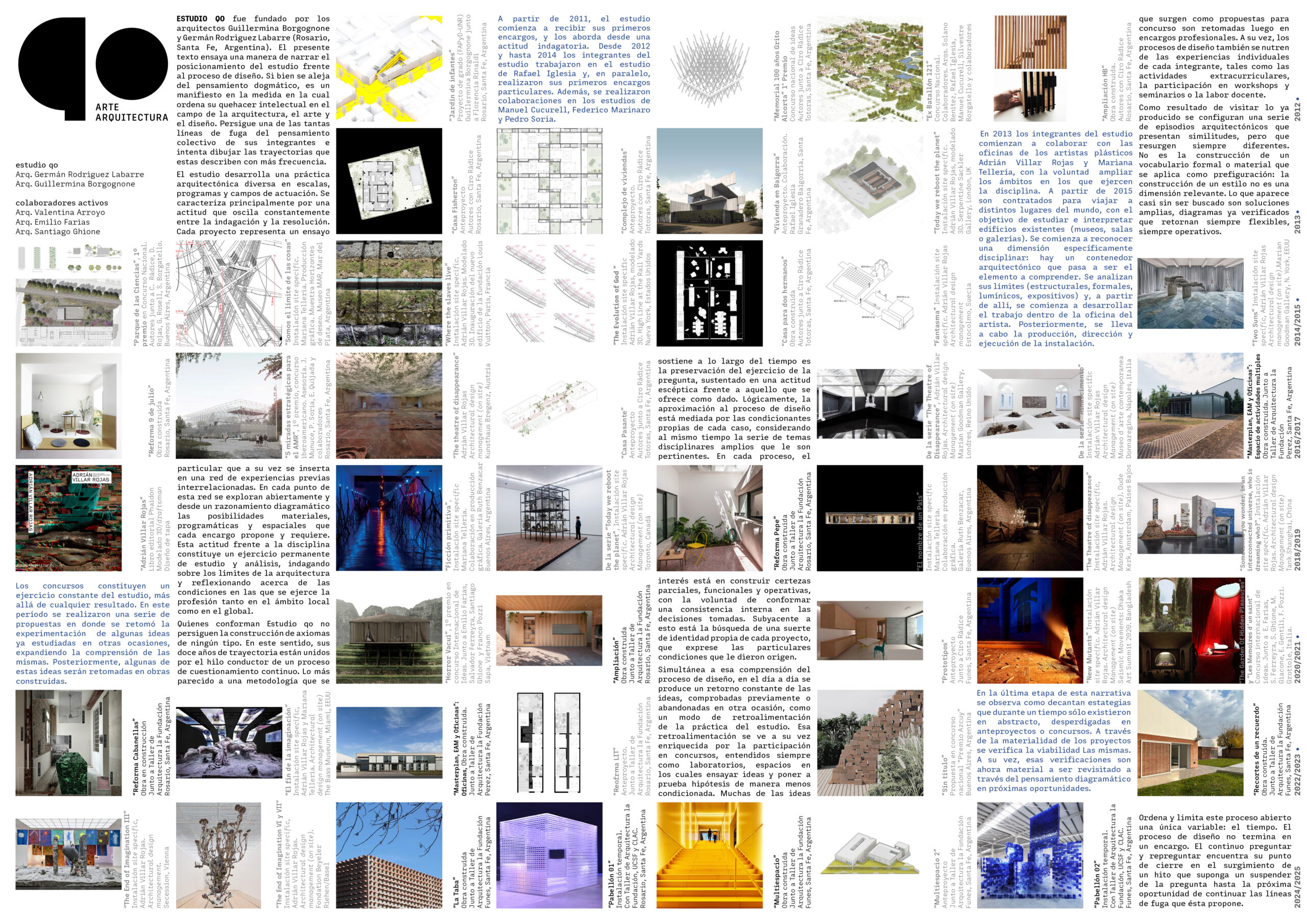
Estudio qo was founded by architects Guillermina Borgognone and Germán Rodríguez Labarre (Rosario, Santa Fe, Argentina). The following text attempts to articulate the studio’s stance toward the design process. While it distances itself from dogmatic thought, it may be considered a manifesto insofar as it organizes the studio’s intellectual practice within the fields of architecture, art, and design. It follows one of the many lines of flight within the collective thinking of its members and seeks to trace the trajectories they most frequently describe.
The studio develops an architectural practice that is diverse in scale, program, and field of action. It is primarily characterized by an attitude that constantly oscillates between inquiry and resolution. Each project represents a specific experiment that, in turn, becomes part of a network of interrelated prior experiences. At each point within this network, the material, programmatic, and spatial possibilities of every commission are openly explored through diagrammatic reasoning. This disciplinary attitude constitutes an ongoing exercise of study and analysis, questioning the boundaries of architecture and reflecting on the conditions under which the profession is practiced—both locally and globally.
The members of Estudio qo do not seek to construct any kind of axioms. In this sense, its twelve years of trajectory are linked by the common thread of a continuous process of questioning. The closest thing to a sustained methodology is the preservation of the act of asking, supported by a skeptical stance toward what is presented as given. Naturally, the approach to design is mediated by the specific constraints of each case while simultaneously considering the broader disciplinary themes that pertain to it. In every process, the aim is to construct partial, functional, and operative certainties, striving to build internal consistency within the decisions made. Underlying this is the search for a kind of identity unique to each project—one that expresses the particular conditions that gave rise to it.
Parallel to this understanding of the design process, the studio’s daily practice involves the constant return of ideas—those previously tested or once set aside—as a means of feedback within the practice itself. This feedback is further enriched by participation in competitions, which are always conceived as laboratories: spaces for testing ideas and hypotheses in less constrained contexts. Many of the concepts initially proposed for competitions are later revisited and refined in commissioned projects. Moreover, the studio’s dynamic is nourished by the individual experiences of its members, such as extracurricular activities, participation in workshops and seminars, and academic teaching.
Through the continuous revisiting of prior work, a series of architectural episodes emerge—similar in certain aspects, yet always distinct. This is not the construction of a predetermined formal or material vocabulary. Within the studio, the pursuit of a style is not a relevant dimension. What tends to appear, almost unintentionally, are broad solutions—verified diagrams that return time and again, always flexible, always operative.
This open-ended process is governed and ultimately bounded by a single variable: time. The design process does not conclude with a commission. The ongoing act of questioning finds a temporary closure in the emergence of a milestone—an event that suspends the inquiry, if only until the next opportunity to continue along the lines of flight it has set in motion.