Competition, 2025 / Venice, Italy
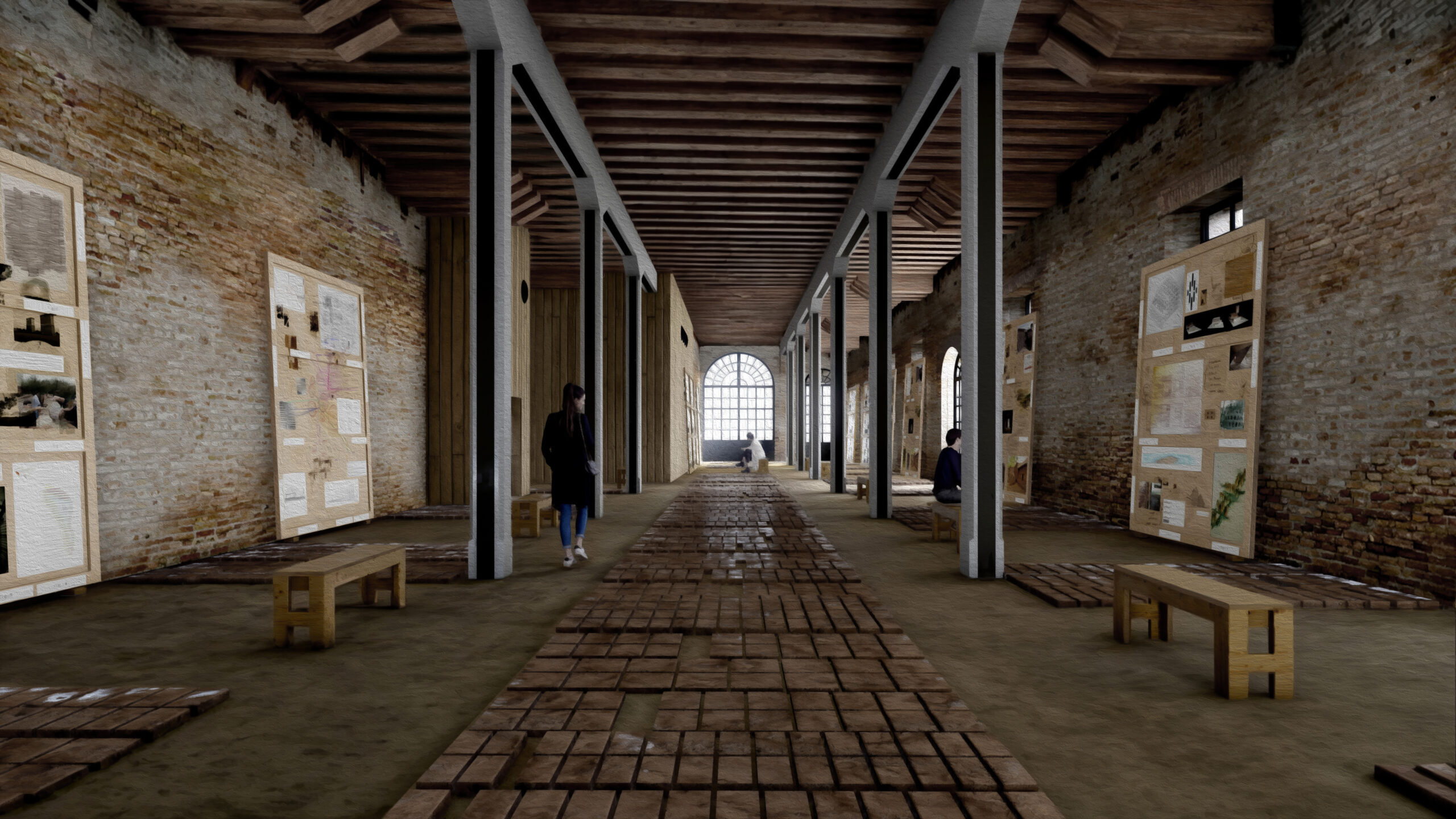
The 19th Venice Biennale invites us to reflect on the multiple types of intelligence gathered around the production of architecture. Rather than focusing on finished products, this proposal is an observation of architectural processes, drawing attention to that multiplicity of intelligences. On one hand, the pavilion will center on the process of brick-making, a building element found throughout Argentina. On the other, the selected works will be exhibited through materials generated during their design processes (sketches, annotated plans, hand-drawn details, screenshots, etc.).

The Installation
Carlo Ratti’s curatorial statement invites us to explore “a definition of“intelligence” as an ability to adapt to the environment with limited resources, knowledge, or power”. Taking this into consideration, our proposal focuses on the brick as a constructive element present across the entire Argentine territory. The brick is a display of an ancestral wisdom (once forgotten, now slowly and necessarily recovered): the act of building with largely availiable, local resources ofered by any given land or region.
Argentina—vast in its extension, landscapes, and climates—is largely unified by the availability of earth. By choosing the brick as the object of reflection, we emphasize this natural intelligence: the ability to build with what is at hand, understanding the logic and limitations of local resources. The artificial logic of the process lies in the Cartesian operation of standardization and geometric regularity that makes any masonry unit practical. At the same time, brick-making is always a collective process—typically familial or community-based—gathering efforts around a production that is both systematic and artisanal.
During the Biennale, the Argentine Pavilion will become a brickyard—a space filled with raw, unfired bricks laid on the ground to dry. In doing so, the process is suspended at a crucial moment, since the drying stage directly impacts the final quality of the product. The material remains in a state of pure potential and pure fragility.
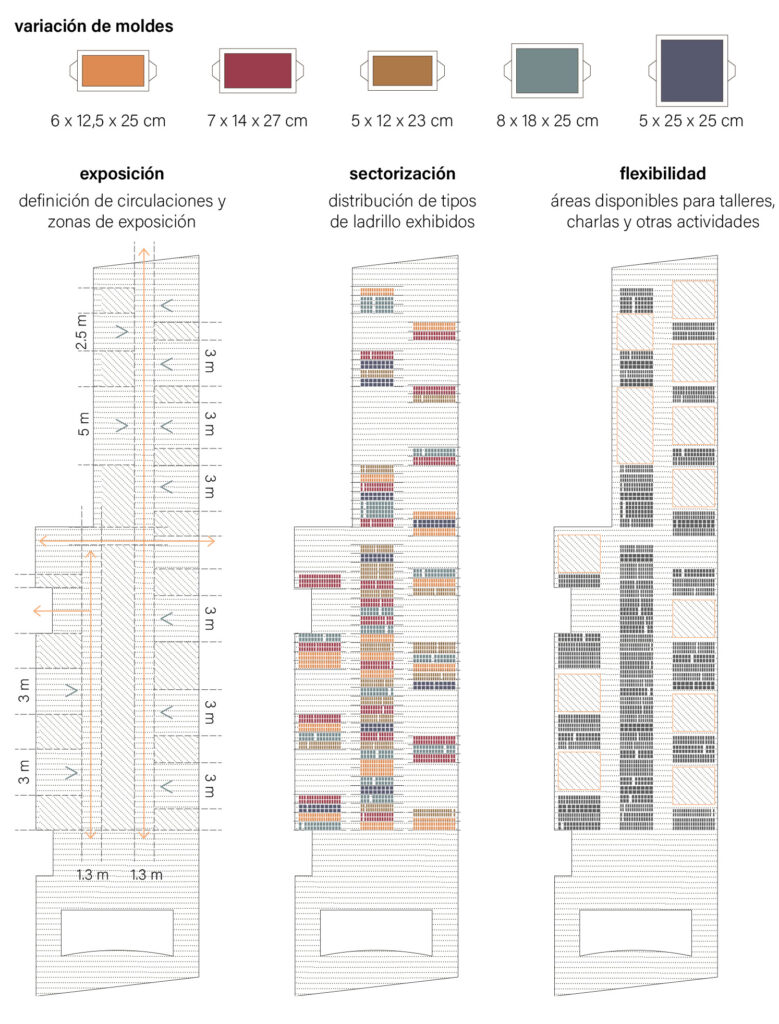
The bricks will be shaped using five different molds brought from Argentina—serving as a reminder of the diversity and heterogeneity of their origins—and arranged to define circulation paths and spaces for the exhibition, workshops, and talks. Throughout the pavilion, a series of wooden stools will be placed, similar to those typically built on construction sites using leftover materials. These can be used to sit and observe the exhibit or rearranged to accommodate the diverse activities taking place.


Curatorial Approach
The curatorial strategy presents a non-linear reconstruction of the design processes behind the selected works, choosing examples notable for their ingenuity in construction, resourcefulness, or use of brick. This approach allows the intelligence of Argentine architecture to unfold in full dimension through sketches, 3D models, annotated plans, or screenshots. Architects will be encouraged to share materials that reveal how their projects were conceived, including subtle variations, discarded ideas, or abandoned paths. Additionally, the inclusion of historical references—consciously or unconsciously related to the works—will be encouraged, as well as connections to popular culture: anonymous, authorless constructions that generously offer their ingenuity throughout the territory.
The exhibition will be mounted on phenolic plywood boards, cut and modulated to maximize material efficiency. These boards will be placed within the areas outlined by the raw bricks. As if they were canvases turned backward, the smooth side will face the wall, exposing their structure and revealing the "behind the scenes" of the selected works. The materials will be affixed to these panels, printed on standardized sheets to facilitate production. Shifting the focus away from finished products, the exhibition will explore the resources mobilized during the design process, creating a map of possible worlds which, as Ratti notes in his message to participating countries, shows that “while some ideas are destined to fail, others may point us toward redemption.”
Finally, Argentina’s contribution to Ratti’s theme—"one place, one solution"—will be the multiplicity of solutions discovered daily by architects and builders: the ingenuity of making use of whatever is at hand


QO
Project
Collaborators
Valentina Arroyo
Emilio Farias
Santiago Ghione
Project
“Procesos”
Competition
Entry
Location
Venice, Italy
Year
2024