Competition entry, 2021 / Grottole, Italia


A first encounter with the site might leave one overwhelmed with the beauty of the Church as it is found. What kind of architecture can contribute to the undeniable appeal of a building that, while somewhat runned-down, still holds the solemnity provided by the passing of time? How does one preserve architectural heritage without reifying it, without fetishizing the ruin to the extent of avoiding intervention all together? Is there a way to reuse its formal repertoire to enrich its spatial disposition without being overtly nostalgic? From this set of questions arises the certainty of a need to face the project with a “strategic withdrawal” attitude.
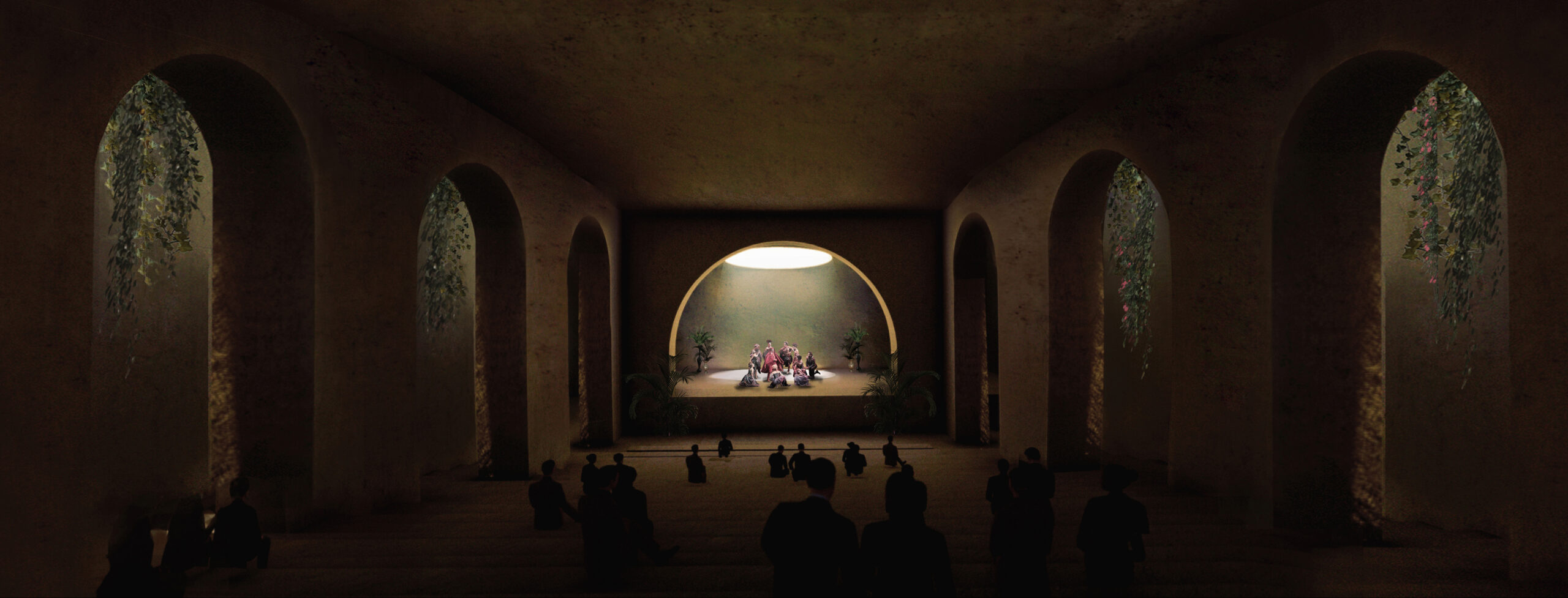
If the original qualities of the church are not to be altered, the alternative arises from a reading of the site. On the one hand, it takes advantage of the difference in ground levels to position itself beneath the ruin; in this initial move echoes the primal gesture of seeking shelter in a cave. On the other hand, the understanding that, in the city of caves, an underground auditorium establishes a meaningful dialogue with Grottole’s historical evolution. Thus, the ground is hollowed out, replicating the church’s floor plan: the auditorium and foyer are placed within the central nave, while circulation areas and service spaces are arranged alongside.
Once the programs have been positioned, the intervention proceeds to act upon the ruins. The first step is to identify all compromised and potentially hazardous areas within the collapsed sections of the church. In those places where the building mass presents irregular breaks on the verge of collapse, selective demolition is carried out—an operation of cutting that also serves to refine geometric imperfections. The remaining surfaces are then restored and reinforced to preserve their original texture.
The next step is to recompose the form of the church. Two aspects are vital: the extensive digital documentation of the building in its current state, and the quantity of material recovered from the two previous operations. The first enables the design of a formwork system that allows for the replication of the existing formal repertoire. The second provides a supply of material to be reused in the construction of new walls and arches that complete the structure. Without resorting to a nostalgic, regressive, or idealized restoration of the “original” church—understanding that its form is the result of centuries upon centuries of events—this act of completion seeks only to go as unnoticed as possible.
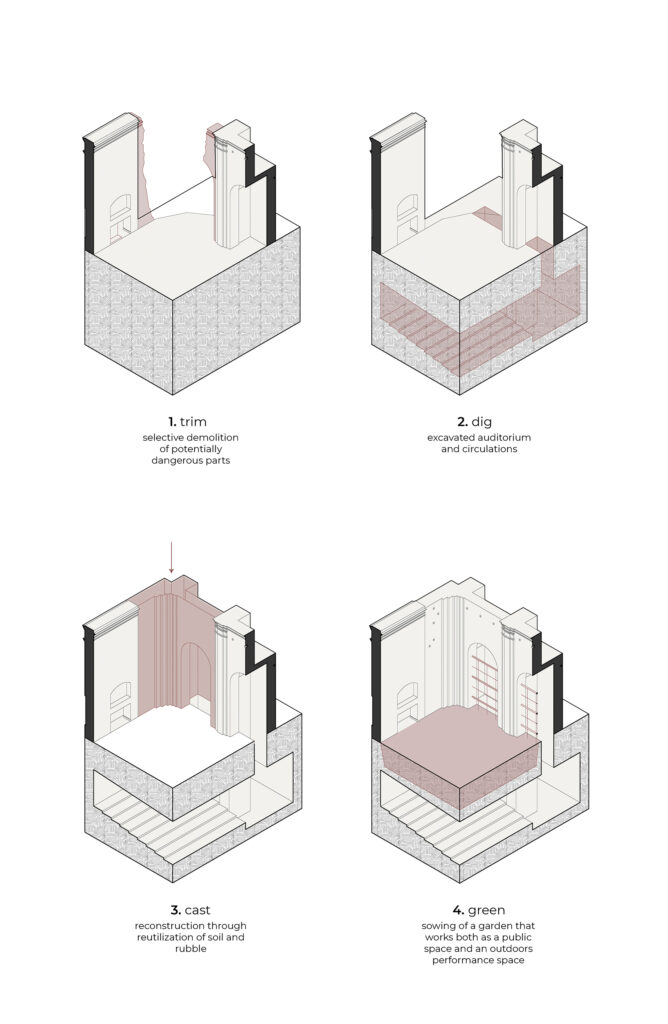

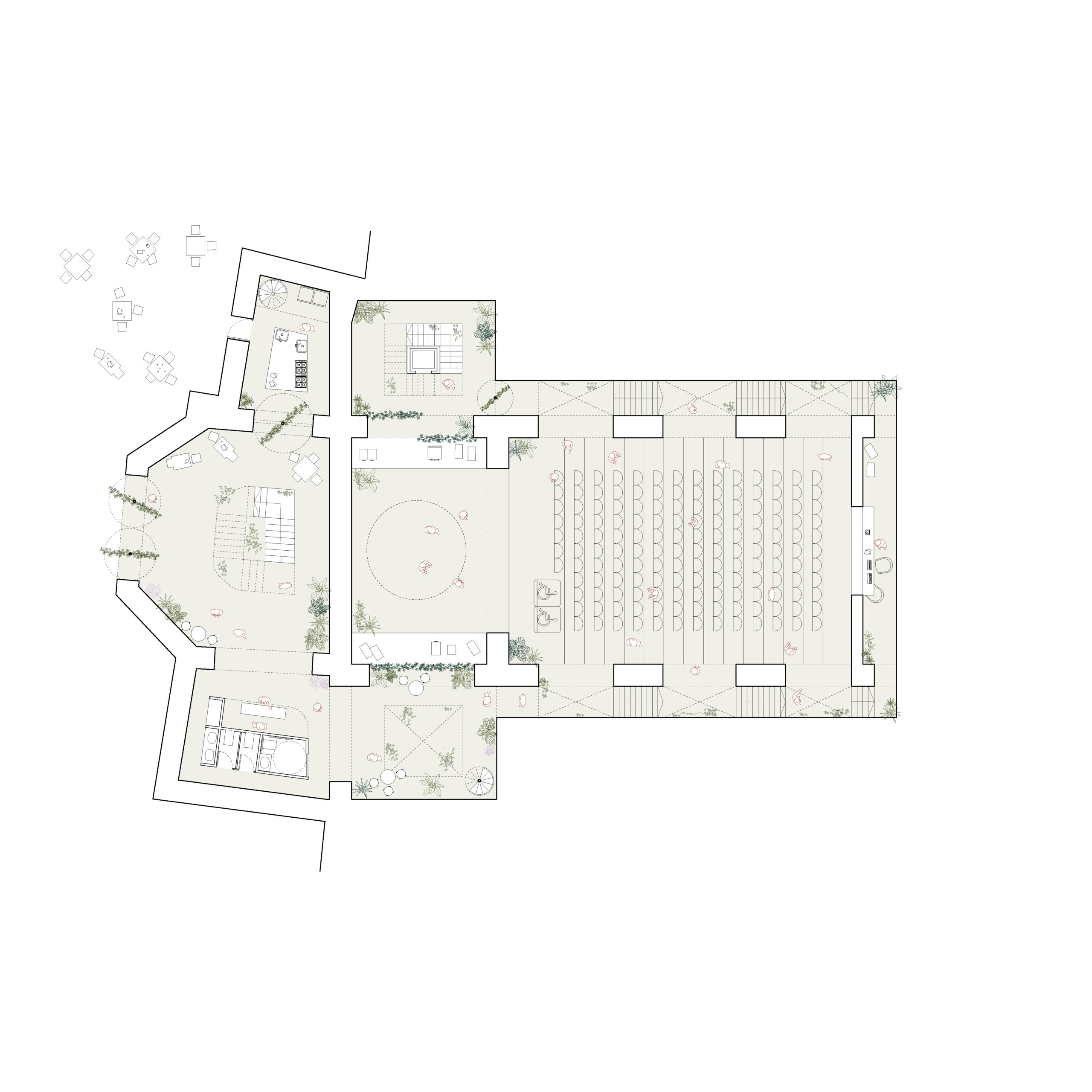
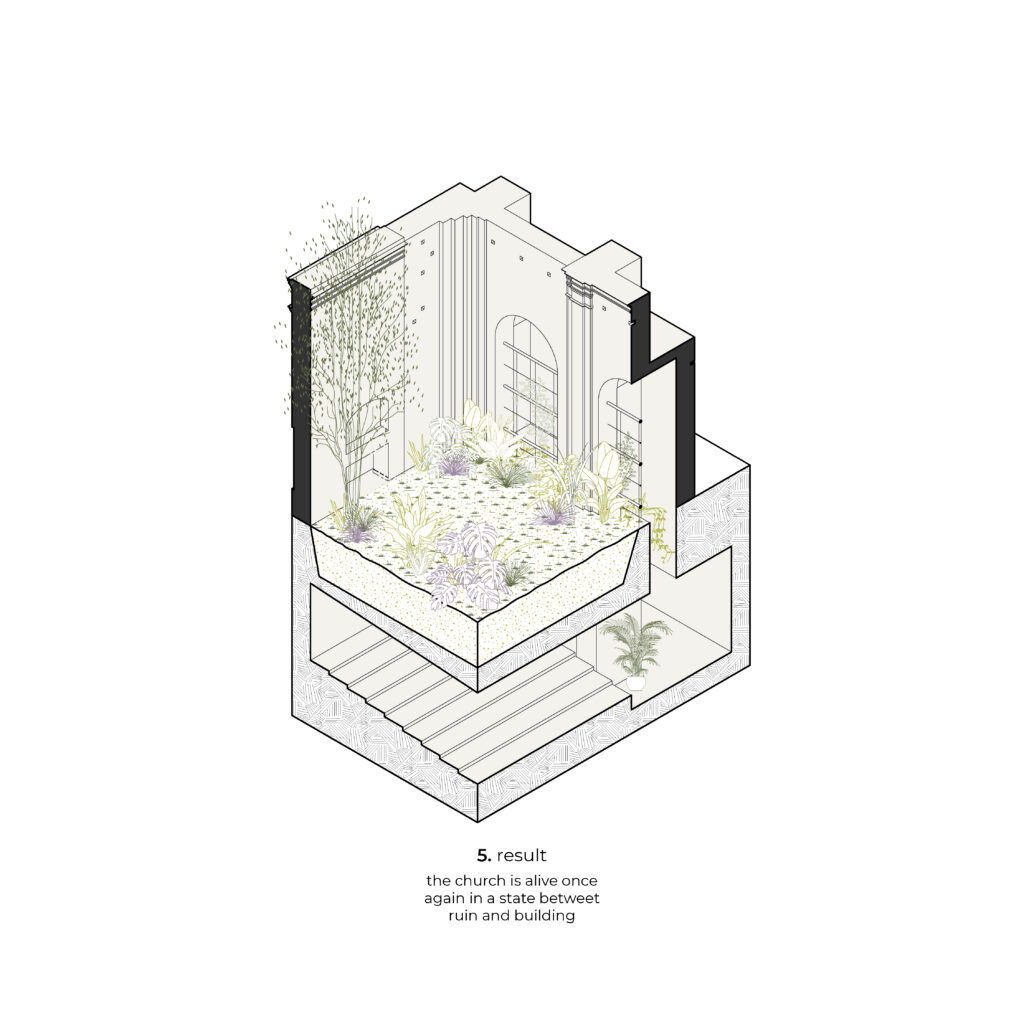
Invariably, the roof is the first to give way to the passage of time and the elements. The decision is made to preserve its current condition as an open-air space, choosing instead to create a garden that grows atop the cave that houses the auditorium: the ruin becomes a veil that conceals the hidden garden.
Architecture always entails, to some extent, the construction of a fiction. Two fictional realms are thus established, each echoing a Dantean physiognomy. Above, Eden: the enchanted garden where the sky becomes the privileged spectator of the most varied artistic expressions. Below, the circular ruins of Hell: a space conceived for tragedy, where light from the garden seeps through unexpected cracks and vegetation peeks in—perhaps as a reminder that beyond the fiction lies a world painted in green and sky, waiting for us when we finally emerge from the cave.
Authors
Estudio qo
Emilio Farias
Salvador Ferreyra
Evelyn Gentili
Santiago Ghione
Mariana Giacone
Franco Pozzi
Project
“THE GARDEN OF HIDDEN PLEASURES”
Competition
Entry
Location
Grotolle, Italia
Year
2021